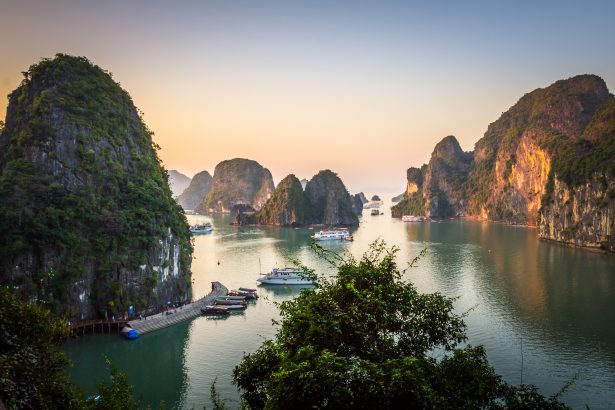
Ha Long Bay: Best place for nature and geography lovers
With its beautiful emerald-green waters and cluster of imposing limestone outcrops rising from the water, Ha Long Bay is almost other-worldly in its beauty. Located about 130km east of Hanoi in northern Vietnam, this stunning bay features more than 2,000 islands, intriguing caves, grottoes, sinkholes, karsts and lakes - truly a visual feast for the eyes and an unforgettable experience for natural landscape lovers.
Hanoi: Best place for a taste of Vietnamese urban life
If you want to dive into Vietnamese city life, Hanoi is the place to do it. This city, which is the capital of Vietnam, is the heartbeat of the nation. Be prepared to get a taste of its frenetic pace, the constant rumble of motorbikes whizzing by, and the clamour of street vendors. At the heart of Hanoi is its Old Quarters, an open-air museum featuring historic Asian and French colonial architecture that has still remained largely intact despite bombings during the Vietnam war. Other prominent landmarks to visit include the Grand Opera House, the Presidential Palace and Saint Joseph Cathedral.
Hoi An: Best place for a taste of old Vietnam
You'll find that Hoi An is one of the most atmospheric cities in Vietnam, with traces of its surviving history still evident. The old town quarter is a particularly great place to explore, characterised with well-preserved merchant houses that date back to Hoi An's role as a trading hub in the 15th century. Most of the old merchant houses are open to the public, so you'll get a rare glimpse into a distant era of Vietnamese history.One of the city's popular landmarks is the scenic Japanese Bridge (pictured to the left) at the end of Tran Phu Street, closely located to the Assembly Hall of the Fujian Chinese Congregration, the town's most esteemed temple. You'll also find numerous pagodas and museums scattered around the town, but Hoi An's main charm and appeal truly lies in the streets of its old towns.
Sapa: Best place to experience Vietnam's higher altitudes
Surrounded by picturesque mountains, lush verdant rice terraces in every imaginable shade of green, and home to a diverse mix of the country's ethnic minorities (like the Hmong, Giay and Red Dzao tribes) is Sapa. This is the top trekking destination in Vietnam, as Sapa is frequently used as a base point to scale the jagged peaks of the Hoang Lien Son Mountains and to tour the rice paddies and villages. The mountains are still known by their French colonial era name as the Tonkinese Alps, making Sapa worth a visit for its absolutely beautiful rural vistas.
Nha Trang: Best place for a beach party
Nha Trang, a popular seaside resort city, is the place to be if you're seeking to frolic and sunbathe by the beach in the day and sink your teeth into a bit of nightlife after. Scenic mountains, beaches and lush islands make it a popular destination among Vietnamese, tourists and dedicated scuba divers. This well-maintained beach extends up to 6 kilometres along the shores of central Nha Trang city and features great resorts, palm trees and a beautiful promenade.If you get bored of sunbathing, the ancient and historical Po Nagar Cham Towers to the north across the Xom Bong Bridge is worth a visit. This temple has been a place of worship since at least the 7th century. There is also a great museum dedicated to the work of Alexandre Yersin who discovered the cause of the bubonic plague and was responsible for founding Nha Trang's Pasteur Institute.
My Son: Best place for ancient temple ruins
My Son is a ruined Cham era temple city that dates back to the 4th century. Originally a historical Hindu religious site, the city was still very much an active site of worship during the 7th to 10th centuries, before falling into complete decline and abandonment in the 13th century. You'll still be able to visit and explore the 20 temple structures that still remain, which physically bear interesting influences from various Asian empires from India and the Malay archipelago. Some of the most important monuments were deliberately destroyed by US forces during the Vietnam War. You can get plenty of interesting nuggets of information and history about the Cham at the museum on-site.
Mekong Delta: Best place for a glimpse of the floating markets
In the extreme south of Vietnam lies the Mekong River, characterised by lush paddy fields, mangroves and fruit orchards, rich with the chaos of the local life and fascinating floating markets you get to explore by boat. A trip to Vietnam is not complete without a visit to the delta, which you can access from Can Tho.
Ho Chi Minh City: Best place for a taste of urban life in south Vietnam
Lying along the Saigon River near the Mekong Delta in Vietnam's south is Ho Chi Minh city. Formerly known as Saigon, the city serves as the capital of South Vietnam during the Vietnam War. At present, Ho Chi Minh City is the largest city of the now-reunified country and offers plenty of reasons to visit, with its historic attractions like Notre Dame Cathedral and Reunification Place, eye-opening museums like the sobering War Remnants Museum, and its vibrant nightlife scene. This bustling and increasingly cosmopolitan city is also a great starting point to visit other parts of Vietnam like Nha Trang.
Dalat: Best place for cool weather in Vietnam
Dalat is a charming city in the South Central highlands of Vietnam, with cool weather year-round and beautiful landscapes of misty valleys, pine trees, and vibrant flowers. It is thus not surprising that Dalat was once the go-to summer retreat destination of Vietnamese emperors and French colonials. This walkable city offers beautiful scenes of classic French colonial architecture and villas, nestled amidst idyllic landscapes - a definite change of scenery from the rest of Vietnam.
Hue: Best place to visit stunning pagodas
Hue, one of Vietnam's most historic towns, is brimming with vestiges of the 19th-century Nguyen emperors. Lying along the banks of the stunning Perfume River is the Imperial Enclosure; spanning across 2.5 kilometres, this palace with its intricately lacquered interiors is certainly worth a visit of the historical Vietnamese monarchy. You can opt for a day tour on the riverboat cruise along the Perfume River, which lets you visit several royal tombs and stunning pagodas. The best tomb to visit is the Tomb of Tu Doc and the most prominent pagoda in the town is the Thien Mu Pagoda, which has a tower that rises up to 21 metres.